Skip to content
Louvre Ops DB

INFO20003 Database Systems · University of Melbourne · 2020 Semester 1

Louvre Ops DB

The entity-relationship design I submitted in April 2020 for the Louvre's ticketing database, rebuilt from the original MySQL Workbench file.

As designed (2020) against refined (2026)

What changed in the schema, and why

The 2020 model is shown exactly as submitted; the refined schema that runs the demo database sits beside it. Every change below links to the design-review finding behind it.

tables
1619
relationships
1823
columns
6984
views
02

3 kept6 restructured4 split2 merged1 replaced by a view

  1. Ticketticket

    restructuredThe barcode keeps its own unique column beside a numeric key, the ticket points at a whole order, and the transport question moves to the first entry scan.

    Why: Foreign keys point at part of a composite key; Re-entry through the same gate cannot be recorded; Where a sale happened is only recorded for card payments

  2. Invoicespurchase_orderorder_line

    splitOne invoice row per product became an order with order lines, so a sale can hold several products, records when and where it happened, and every foreign key points at a whole key.

    Why: Foreign keys point at part of a composite key; No purchase records when it happened; A foreign key joins text to a number

  3. Productproduct

    keptSame role. Prices are integer euro cents instead of FLOAT, and each product has a fixed code.

    Why: Spaces and typos in names

  4. Payment Methodspayment

    restructuredOne row per payment with a single method column, instead of a primary key built from two optional columns.

    Why: Payment Methods has optional columns in its primary key; A foreign key joins text to a number

  5. EFTPOScard_paymentfinancial_institution

    splitCard details become a subtype of payment sharing its key; banks move to their own table; card digits are stored as text so leading zeros survive.

    Why: The masked card number is stored as an integer; Where a sale happened is only recorded for card payments; No purchase records when it happened

  6. Cashcash_payment

    keptStill the first name, city and country of a cash payer, now a subtype of payment sharing its key.

    Why: Payment Methods has optional columns in its primary key

  7. Entranceentry_scanentrance

    splitEvery entrance scan gets its own row and key, so re-entry through the same gate fits; the five gate names become a lookup table.

    Why: Re-entry through the same gate cannot be recorded

  8. Wingswing_scanwing

    splitKeyed by the wing's name, the 2020 table could hold three rows in total. Each wing scan now has its own row, ticket and time; the wings become a lookup table.

    Why: Wings can store only one visit per wing, ever

  9. Hired Audio Guideaudio_guide_hirelanguage

    restructuredEach hire has its own key and records the order that paid for it; the 13 languages become a lookup table instead of an ENUM.

    Why: Audio guides still in service cannot be registered; Spaces and typos in names

  10. Audio Guide Deviceaudio_guide_device

    restructuredThe retirement date is optional, so a device still in service can be registered (and its hires stored).

    Why: Audio guides still in service cannot be registered

  11. Special Exhibitionexhibition

    keptSame role, with its run dates and the places per slot.

    Why: Time slots have no date and no exhibition

  12. Time Slotexhibition_slot

    restructuredA slot is now a dated 15-minute slot of one exhibition, with its capacity, instead of a time of day shared by every exhibition.

    Why: Time slots have no date and no exhibition

  13. Exhibition Bookingexhibition_booking

    mergedMerged with Booking Ticket: one row per ticket per slot, with its own key, and a trigger that stops overbooking.

    Why: Foreign keys point at part of a composite key; Three overlapping ways to link tickets and bookings, and a stored count; Time slots have no date and no exhibition

  14. Booking Ticketexhibition_booking

    mergedIts only job, linking tickets to bookings, is now a column of exhibition_booking.

    Why: Foreign keys point at part of a composite key; Three overlapping ways to link tickets and bookings, and a stored count

  15. Hall Napoleonhall_napoleon_scan

    restructuredAn admission belongs to one booking (at most one per booking), so attendance can be traced to an exhibition.

    Why: Three overlapping ways to link tickets and bookings, and a stored count; Time slots have no date and no exhibition

  16. Actual Number of Visitorslot_availability (view)

    replaced by a viewA stored count that could drift from the rows it counts becomes a view computed from bookings and admissions.

    Why: Three overlapping ways to link tickets and bookings, and a stored count

  17. newmuseum_visit (view)

    One row per visit (a ticket's first entry), for counting visitors.

The brief

What the assignment asked for

The case study cast students as the team designing a transactional MySQL database for the Louvre: how visitors buy tickets, how they move through the entrances and wings, and how audio guides and timed exhibition bookings work. The deliverables were a conceptual model in Chen's notation, a physical model in Crow's-foot notation built in MySQL Workbench with up to 400 words of assumptions, and the .mwb file. Worth 10%, due 3 April 2020. No SQL had to be written; the brief listed ten business questions the design should be able to answer.

Tickets and payments

Visitors buy tickets online in advance or at an entrance on the day, by card, digital wallet or (on site) cash. For cards the museum keeps the bank, branch and country, the account name, a masked card number and the expiry; for cash, only a first name, city and country.

  • €15 online
  • €17 on site
  • One method per payment

Entrances and wings

Tickets are scanned at one of five entrances, and again at each of the three wings. The first scan of the day records how the visitor travelled; a ticket is valid until closing that day and can re-enter.

  • 5 entrances
  • Richelieu · Denon · Sully
  • 7 transport modes

Audio guides and the app

Guides are hired at a wing and returned at any wing. The museum wants the language, both wings and how long each guide was out, and keeps a register of devices by serial number. The official app is sold through the app stores.

  • 13 languages
  • €8 per hire
  • €4 app

Special exhibitions

Exhibitions in the Hall Napoleon are included in the ticket but must be booked in timed slots with limited places. The museum must always know how many places are booked, admitted and still free in every slot.

  • 15-minute slots
  • Up to 45 places
  • Leonardo da Vinci at 500

April 2020

What I built then

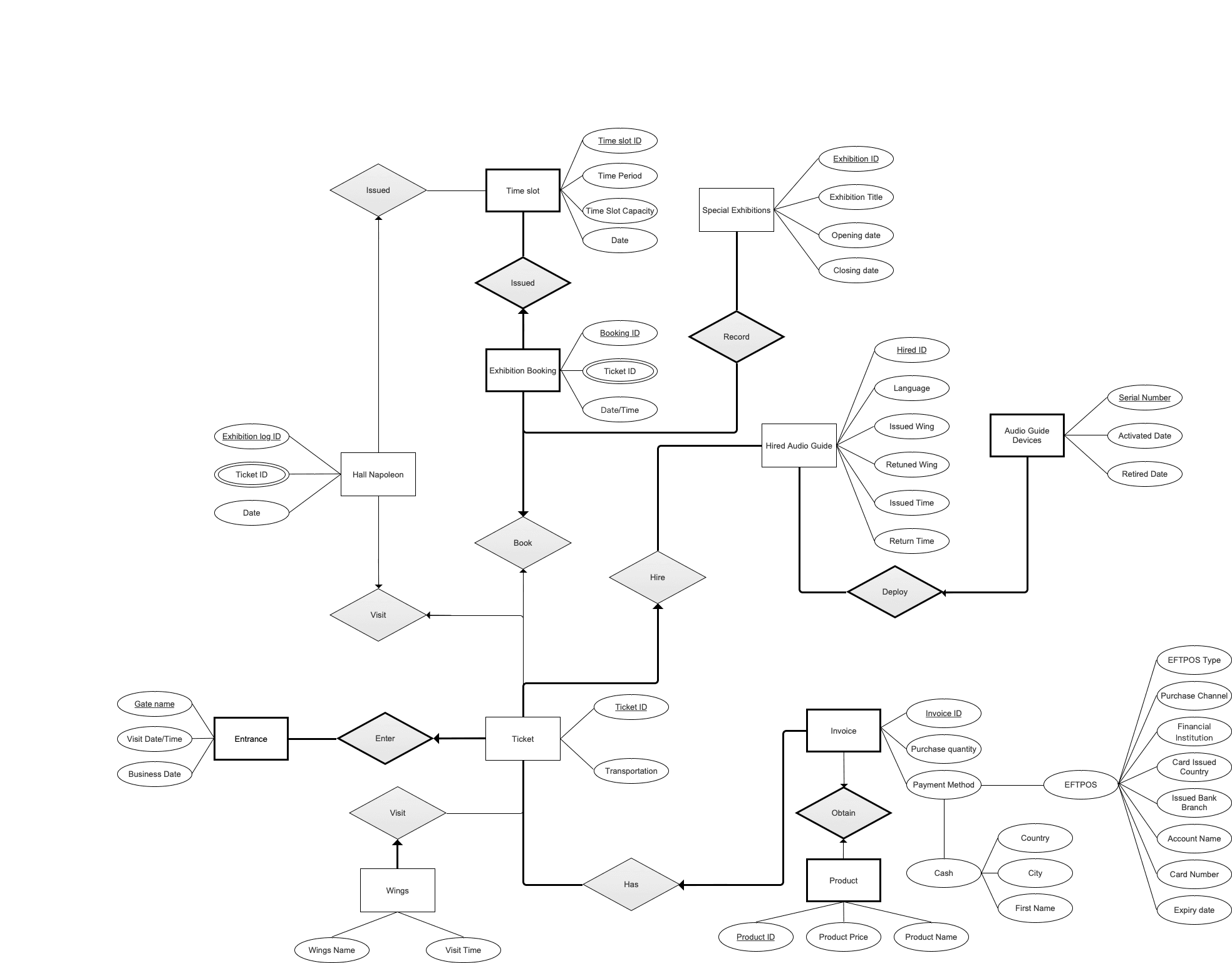
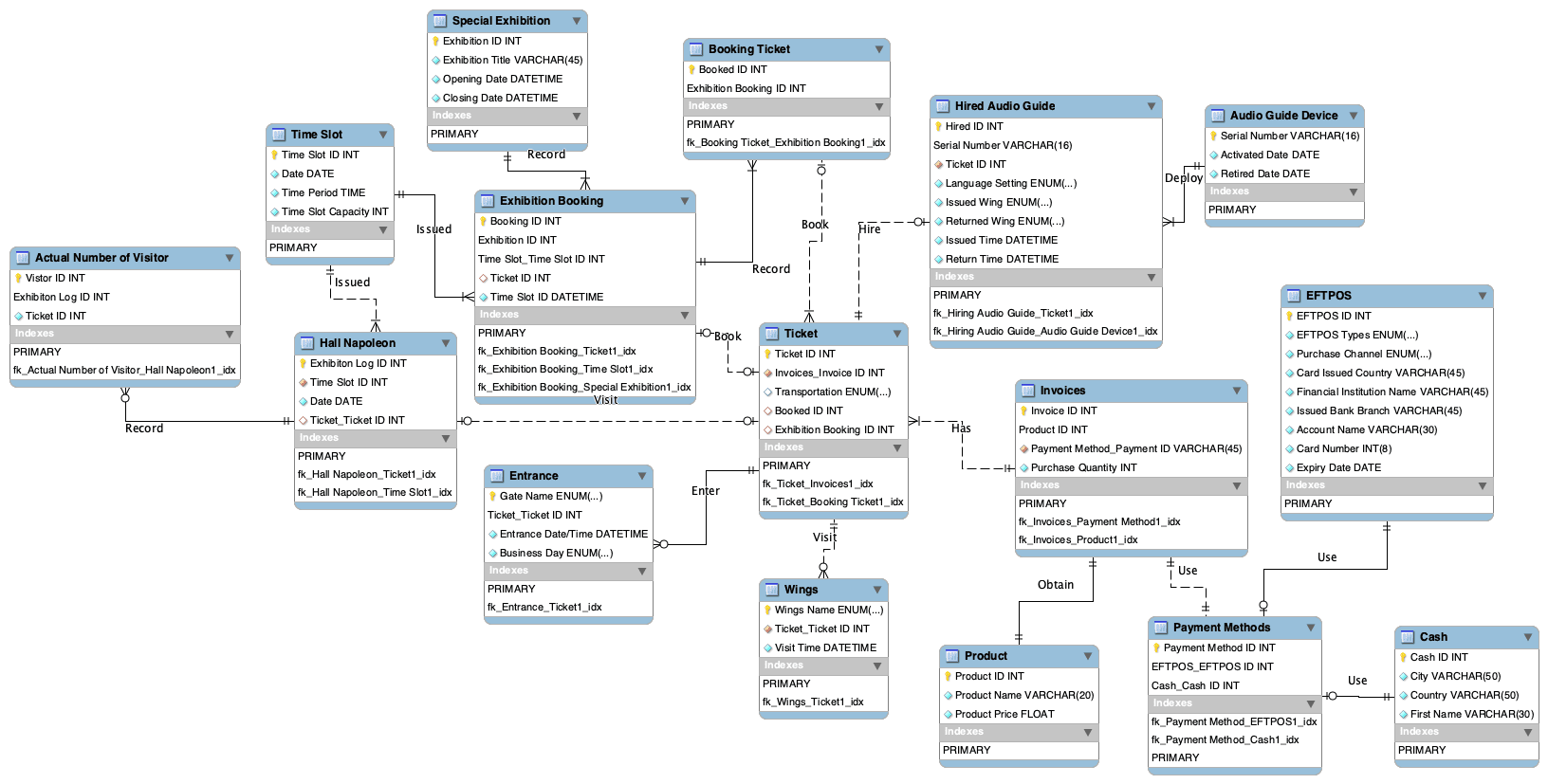
A Chen diagram of 11 entities and 11 relationships, drawn in Axure; a physical model of 16 tables and 18 foreign keys in MySQL Workbench; and 13 numbered assumptions explaining the cardinalities. These are the original exports, unchanged.

The 2020 Chen ER diagram
Conceptual model, Chen's notationExplore it
The 2020 MySQL Workbench EER diagram
Physical model, Crow's foot (MySQL Workbench)Explore it

2026 revival

What testing the design showed

I forward-engineered the model to MySQL, replayed five years of synthetic activity through it, and checked it against every question in the brief. The diagrams look reasonable; running them is less kind.

13 / 16

tables created on MySQL

Run on MySQL 26.7.0, 3 CREATE TABLE statements fail: a primary key with optional columns and foreign keys that point at half a key. MySQL 8.0, current in 2020, would have created 15.

3 / 19,545

wing visits the Wings table can keep

Wings is keyed by the wing's name, so after one visit to Denon no other can be stored. The order of wings cannot be answered.

6 · 2 · 2

questions answerable · partly · not

Most of the brief's questions can be answered from the 2020 design; the wing questions cannot, and purchases carry no date.

Read the design review

About this project

Credits and context

Subject
INFO20003 Database Systems, University of Melbourne
Assessment
Assignment 1: ER Modelling, 2020 Semester 1, worth 10% of the subject
Author
Sunchuangyu (Rin) Huang (individual assignment, no team)
Original stack
MySQL Workbench 8 (.mwb), Axure RP for the Chen diagram, Microsoft Word
Revived stack
Next.js 16, React 19, TypeScript, Tailwind CSS 4, React Flow, sql.js (SQLite in WebAssembly), libSQL, CodeMirror 6
Data
Synthetic and deterministic (seeded generator); the case study is fictional
Source
A GitHub repository, private for now (the 2020 submission is preserved unchanged in coursework/)
Integrity
The university's brief is paraphrased, not reproduced. If you are taking INFO20003, do your own work.